
Martian Analog (MGS-1 L)
Practical significance
The MGS-1 analog is a mineralogical standard for basaltic soils on Mars, developed based on quantitative mineralogy from the MSL Curiosity rover.
Origin
The MGS-1 (Mars Global Simulant) is made by sourcing individual minerals, including a proper treatment of the X-ray amorphous component. It was developed by the University of Central Florida.
Main constituent
Plagioclase
Cosmic analogs density
compact
Color
Gray
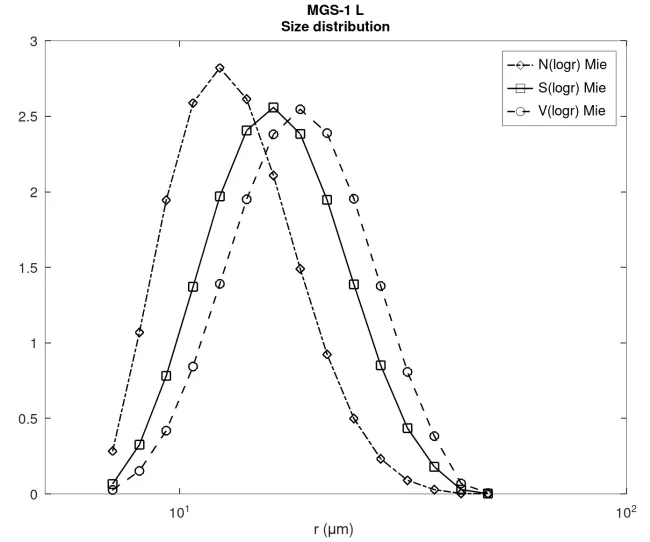
Particle size Mie: reff (μm)
17.4
Particle size Mie: veff
0.12
Particle size
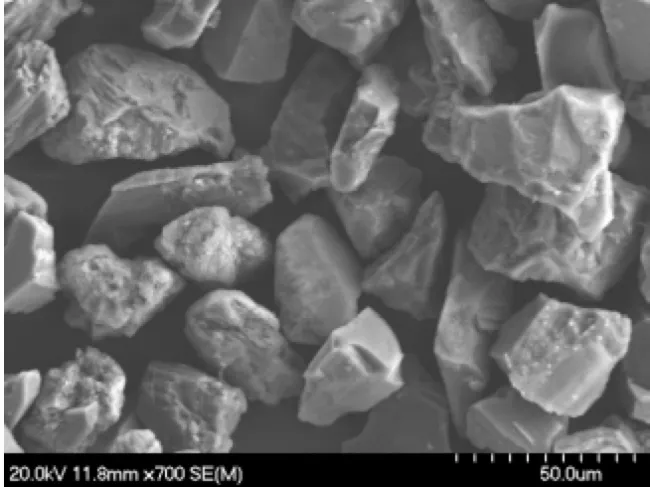
The sample was processed at the Instituto de Cerámica y Vidrio (CSIC-ICV) to produce a narrow particle size distribution of 7<d<40 micrometers.
Size distribution plot:
Size distribution table
SEM/TEM images:
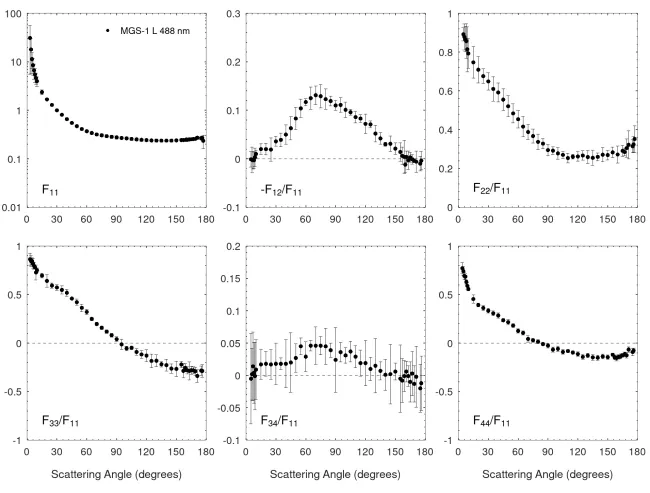
Scattering matrix (1) wavelength in nm
488.00 nm
Scattering matrix (1) table
Scattering matrix (1) plot:
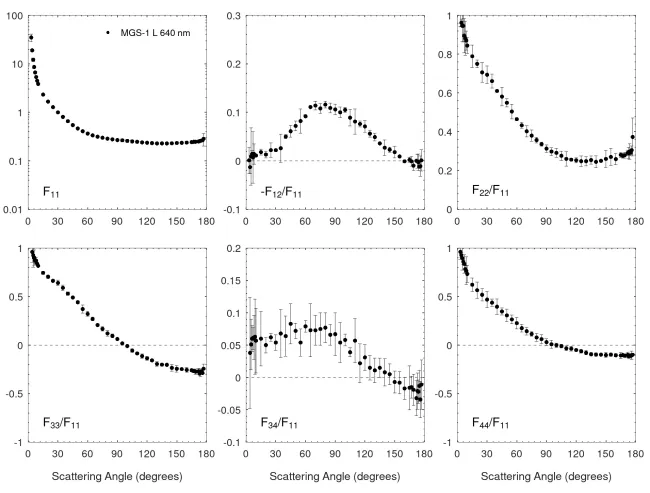
Scattering matrix (2) wavelength in nm
640.00 nm
Scattering matrix (2) table
Scattering matrix (2) plot:
Computed Optical Properties (200–2000 nm)
Below you can download the computed optical properties (200–2000 nm) of the sample. A detailed description of the file format, together with additional information on the methodology used to derive these data, can be found HERE.
Refractive index
The complex refractive indices of the MGS-1 analogue were retrieved using the MGS-1 XL sample for a wavelength range of 200-2000 nm (see Martikainen et al., 2023). For the wavelengths of the scattering matrix measurements, the values were interpolated as shown by Martikainen et al., (2024).
At 488 nm, n = 1.5 and k =0.00042. At 640 nm, n = 1.5 and k = 0.00043.
Optical Properties
Phase matrices
Angle range (deg)
[3,177]
Reference/s